
Logan Projected and Actual Dates
A projected date is a calculation or an eligibility point. It is not proof that a person walked out of a jail or prison. ODRC uses the combined label Expected Release Date/Parole Eligibility Date. One part may describe an expected end of confinement, while the other may mark when the Parole Board can consider release. A court order or favorable parole decision can also come before physical processing. The actual release is stronger when Status, post-event release detail, and the owning agency's record agree.
Custody type controls the answer. Logan County Jail holds pretrial detainees and county-sentenced people. A pretrial person has no sentence end to calculate. Bond may be posted, charges may be dismissed, or another agency may assume custody. For a county sentence, the judgment, court-certified jail-time credit, and Logan Jail's calculation matter. ODRC's public calculation applies only after entry into Ohio prison custody.
Find a Logan Inmate Release Date
Begin with the court and custodian, not with a date copied from an unrelated system. A Logan County arrest that ends at the jail will not necessarily appear in ODRC. A prison commitment should move the search to ODRC, while the county court record still explains the sentence and jail-time credit.
- Identify whether the person is at Logan County Jail, in an ODRC prison, or already under supervision. Confirm the full name and the agency's own identifier.
- For a Logan jail case, read the criminal judgment through Logan County court eServices or the Bellefontaine Municipal Court channel.
- For an Ohio prison term, open the ODRC Offender Search. Search by exact offender number when known, or use a name with sparse filters.
- Read Status, the combined expected-release/parole-eligibility field, POA/PRD, sentence components, jail-time credit, and any next hearing month together.
- After the date passes, confirm release through Status, Parole or Release Detail, Supervision Start, the jail record, or ODRC Central Records as appropriate.
The general Logan County released inmate search explains how the jail record and court docket establish the end of a county custody episode. It also helps identify transfers that should not be called community releases.
ODRC Logan Release-Date Fields
ODRC's person detail can carry several dates with different roles. Expected Release Date/Parole Eligibility Date is the public combined field. POA/PRD Date means parole on or after or projected release date. A Next Parole Board Hearing or Review Month schedules consideration. It is not a departure appointment. Earliest Possible Transfer Date concerns transitional control, while TC/TT Sentence Expiration concerns a halfway-house setting within the corrections framework.
The official ODRC definitions show how the system separates projected, supervision, and post-release fields.
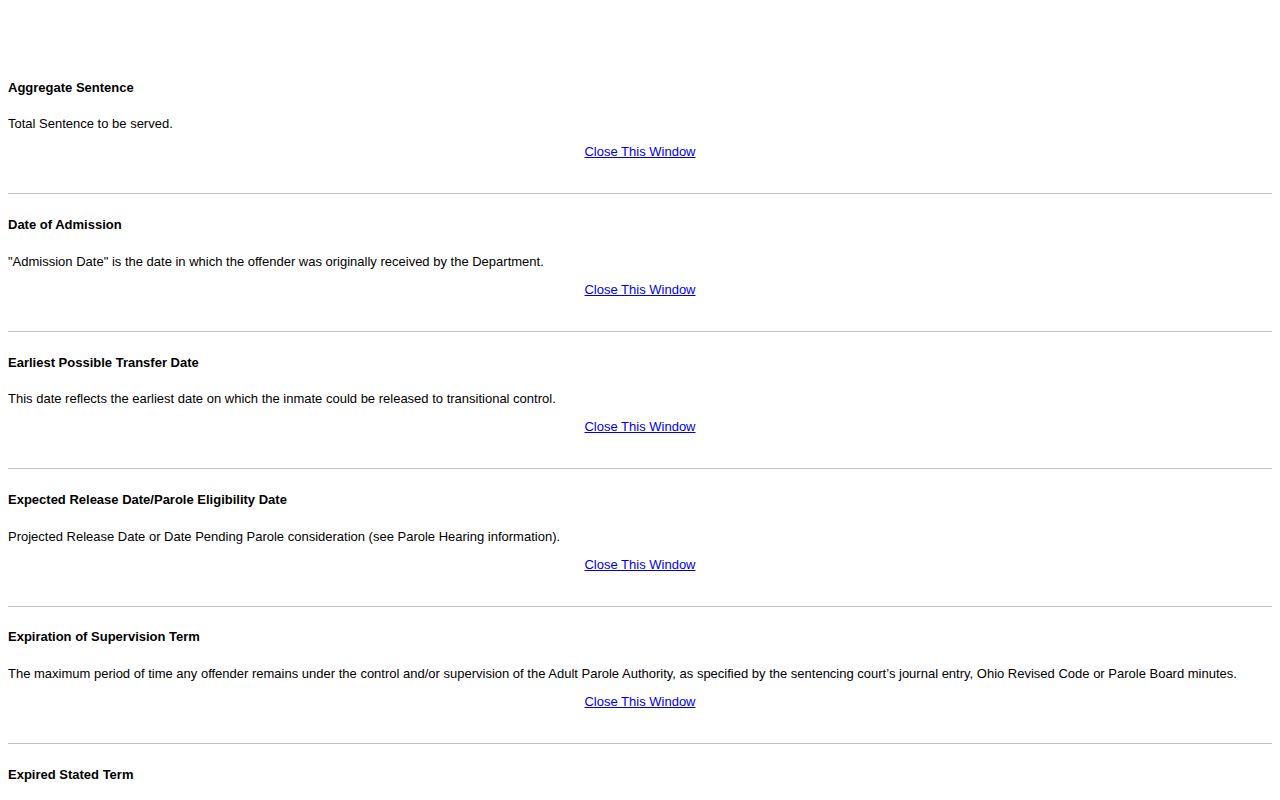
The definitions make one crucial point: Parole or Release Detail appears only after parole or release. That post-event detail and a supervision start are stronger confirmation than the future expected date alone. ODRC also warns that sentence data can be incomplete, so the court journal remains important.
| ODRC field | What it means |
|---|---|
| Expected Release Date/Parole Eligibility Date | A projected release point or a date pending parole consideration |
| POA/PRD Date | Parole on or after, or projected release date |
| Next Hearing Month | A month for Board review, not a guaranteed exit |
| Parole or Release Detail | Post-event information shown after parole or release |
| Supervision Start | The recorded start of APA supervision after release |
How Ohio Computes Logan Dates
Sentence calculation starts with the journalized term. ODRC must separate mandatory and nonmandatory components, use the effective sentence date, and apply court-certified jail-time credit. Jail-time credit under ORC 2967.191 accounts for qualifying pretrial and other confinement. It is not itself a release record. Consecutive terms, multiple counts, and separate cases can change the net sentence, while a detainer can prevent community departure when one term ends.
Ohio has several sentencing regimes. Parole-eligible life and old-law terms depend on statutory eligibility and Parole Board action. Modern definite sentences commonly use post-release control after confinement. Qualifying Reagan-Tokes indefinite terms have minimum and maximum mechanics under ORC 2967.271. That law presumes release at the minimum in covered cases but permits continued custody through the statutory process, up to the maximum. A minimum date is therefore not always the actual date.
The monthly ODRC parole search adds another layer. A scheduled review can occur before the displayed date so the Board can complete consideration. A result of CONTINUED means release did not occur at that review. Even a favorable parole result still requires POA/PRD and institutional processing. Dates must be kept in order: judgment date, admission date, projected or eligibility date, physical release or transfer time, and supervision start.
Logan Earned-Credit Rules
Ohio does not have one universal rule requiring every person to serve 85 percent. The current framework in ORC 2967.194, effective for the governing regime described in the research, permits eligible confined people provisionally to earn one or five days for a completed month of productive participation. Certain eligible completions can produce a 90-day or 10-percent award, whichever is less. Ordinary participation and completion credit outside that special award is generally capped at 15 percent of the stated term.
Eligibility is not automatic. The statute excludes specified mandatory or nonreducible terms and listed serious categories. Conduct, program completion, administrative calculation, denial, and withdrawal can all affect the amount. Older or transition cases may instead fall under ORC 2967.193 and older rules with different limits. Those regimes should not be blended.
The so-called 80 percent paths are also special. ORC 2929.20 allows an ODRC recommendation for certain court-granted judicial releases, subject to eligibility and a court decision. ORC 5120.036 creates a risk-reduction path with required programming and other conditions. Neither promises release at 80 percent. The displayed ODRC field, the governing law, and the judgment must be read together.
Note: Only ODRC and the sentencing court can apply the correct credit regime to a specific Logan County sentence.
Why Logan Release Dates Change
A projected date can move because the underlying sentence, credits, custody status, or release decision changes. The updated agency record controls. A copied date without an as-of time can quickly become misleading.
| Factor | Possible effect | Verification source |
|---|---|---|
| Earned credit | Eligible approved credit can move a projection earlier | ODRC calculation and governing statute |
| Credit loss or withdrawal | Discipline or administrative action can move it later | Current ODRC record |
| Jail-time credit correction | A corrected court finding changes the calculation | Sentencing journal and ODRC |
| Consecutive sentence or detainer | One term may end without community release | Court, ODRC, and receiving agency |
| Parole decision | Grant, continuation, denial, or rescission affects timing | Board result, POA/PRD, and Status |
| Judicial release | A court may authorize early release, followed by processing | Court order and ODRC post-event fields |
Read a Logan ODRC Example
A real ODRC person detail tied to a Logan County commitment demonstrates the expected-release/parole-eligibility label in context. The example is useful for field recognition, not for predicting another person's sentence.
The official Logan commitment example displays the date field beside the case and sentence information used to identify the record.
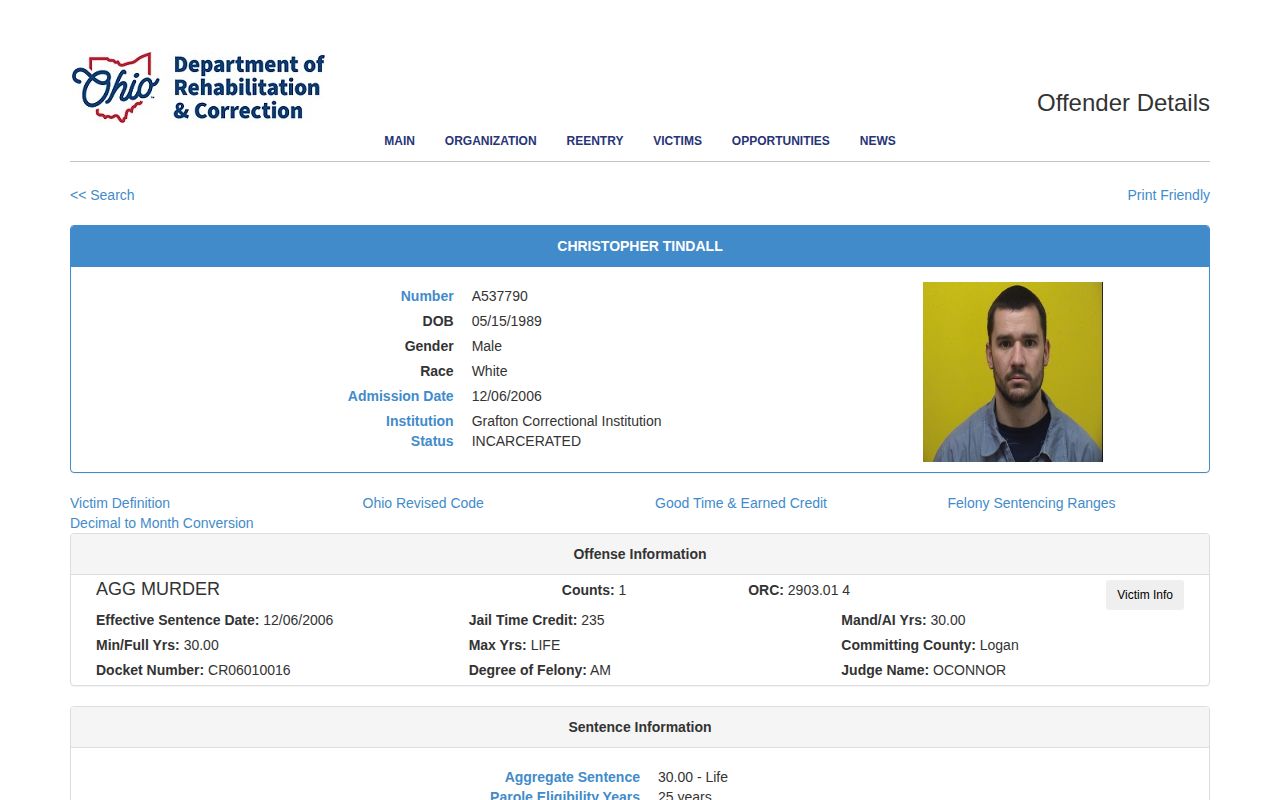
The image shows why identity and sentence fields matter. Broad name searches can return similar people, and County of Commitment can reflect the first county on a multiple-county record. Compare offender number, birth information, docket, county, counts, and effective sentence date before relying on the projected field.
Logan Jail Release-Date Calculation
A Logan County Jail date follows the local judgment and the jail's own custody record. It does not come from the ODRC public search unless the person was committed to state prison. For a county sentence, read the term imposed, whether any parts run at the same time or one after another, and the court-certified jail-time credit. Then ask Logan Jail for the calculation or actual release timestamp. No official county source reviewed publishes a public sentence calculator, regular release hour, weekend adjustment, or guaranteed processing time.
Pretrial custody has a different logic. There is no sentence-expiration date to subtract credits from. Departure may follow posted bond, recognizance, dismissal, a plea and sentence, or a transfer. A judge's order supplies the legal authority, but the jail still must process the event. Record the order date and physical departure time separately. If the person vanishes from the Sheriff app, that absence cannot establish either one because the app has no published retention window.
Felony commitments also create a handoff. The Logan jail record documents when county custody ended and which custodian received the person. ODRC then controls the prison admission, sentence calculation, projected or eligibility date, and later discharge. A county release timestamp in that sequence means transfer to state custody, not release into the community. The two agency records should form one timeline without being collapsed into one event.
If the journal includes judicial release, verify that the order became a completed release. ODRC may later show RELEASED - Judicial Release, release detail, and supervision fields. If it includes a prison commitment, use the ODRC offender number rather than the jail's inmate ID. Each identifier belongs to its own system and should not be moved into another search field without confirmation.
Confirm a Logan Release Event
After a projected date arrives, check the owning agency again. For ODRC, Status plus Parole or Release Detail and Supervision Start are the best public post-event clues. If the record conflicts with the judgment, write ODRC Central Records, P.O. Box 430, Columbus, OH 43216, for discrete releasable information. For Logan County Jail, call 937-592-8111 and request the physical release or transfer timestamp and disposition when needed.
A VINELink Release Check can add an event notice for a specific county or state custody record. It does not certify discharge. A VINE alert may arrive after the source event, and release from one facility can mean transfer to another custodian. Keep the alert, jail or ODRC result, and court order as separate records with their own times.
For a focused ODRC inquiry, request the specific release, parole, or status fields rather than the whole inmate file. Ohio law makes the full ODRC record generally confidential while allowing disclosure of defined items such as supervision status and current or past incarceration place. A narrow question is more accurate and easier for Central Records to identify.